
RBC commends the University of Michigan researchers for including geopolitical considerations alongside emissions and circularity.
WASHINGTON - The Responsible Battery Coalition (RBC), a coalition of leading stakeholders working toward a circular economy for batteries and their critical minerals, today welcomed a new University of Michigan Center for Sustainable Systems study published in the Journal of Energy Storage. The research introduces a framework to evaluate life cycle management for electric vehicle batteries, identifying 17 key drivers to balance environmental, economic, and geopolitical considerations while accounting for tradeoffs across the battery value chain.
Major General Bill Crane (Ret.), Chair of the RBC Critical Minerals Leadership Roundtable and former Adjutant General of the West Virginia National Guard, and Rear Admiral Peter Brown (Ret.), Vice Chair of the Roundtable and former Deputy Assistant to President Donald Trump for Homeland Security and Counterterrorism, issued the following statement:
"This framework recognizes that circularity and national security go hand in hand. A strong domestic battery supply chain ensures America can refine, process and recover the critical minerals that support military readiness, AI infrastructure, grid resilience, and the technologies that power our economy."
Among the study's key findings, the authors conclude that growing demand for critical minerals, combined with the geographic concentration of mining and processing capacity, presents increasing challenges for supply chain resilience. They identify diversified and secure supply chains, responsible sourcing, expanded recycling, and greater use of secondary materials as essential to the technology's continued use and development.
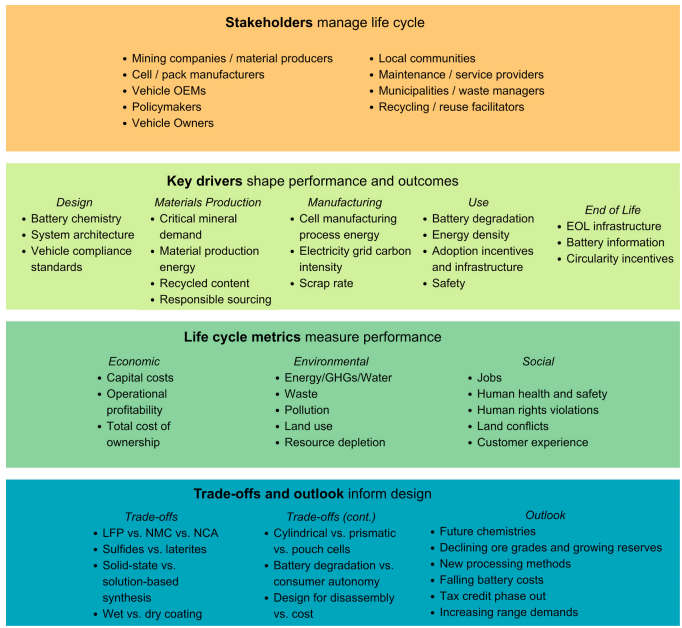
The authors are direct that expanded use of recycled and secondary materials is not simply an environmental priority. It is a supply chain security strategy that reduces dependence on foreign sources and strengthens the domestic industrial base.
The U-M study reinforces the priorities of the Critical Minerals Leadership Roundtable, including expanding domestic processing and refining capacity, strengthening critical mineral supply chains, promoting responsible recycling, and accelerating a secure circular economy for batteries.
It also identifies a closing window on infrastructure: collection, reuse, and recycling capacity must be built well ahead of the first large wave of EV battery retirements.
This framework arrives at an important time as governments and industry continue investing heavily in domestic and allied manufacturing. Hundreds of billions of dollars in cumulative private investment have been committed for U.S. battery manufacturing facilities, further supported by the Trump Administration and bipartisan leadership in Congress through federal grants, loans, permitting reform, tax incentives, trade negotiations, and strategic government equity participation in key projects.
The study draws a clear connection between China's sustained battery supply chain investment and its current market dominance, and warns that policy inconsistencies carry real costs. Remaining competitive requires durable federal commitment, not stop-and-start investment.
These investments are strengthening supply chains for both EV battery production and the rapidly growing demand for grid-scale energy storage, delivering critical benefits for both everyday life and military readiness.
By evaluating sustainability, resilience, and national security together, the research provides policymakers, manufacturers, recyclers, and investors with a practical resource to help guide future policy, investment, and technology decisions.
Read the full study, here.
About the Responsible Battery Coalition
The RBC is a coalition of companies, academics, and organizations committed to the responsible management of the batteries of today and tomorrow. Members include: Advance Auto Parts, AutoZone, Capital City Ventures, Clarios, ENTEK, FedEx, Honda, and O’Reilly Auto Parts. RBC was created in April 2017 to advance the responsible production, transport, sale, use, reuse, recycling, and resource recovery of transportation, industrial, and stationary batteries and other energy storage devices. For more information: https://www.responsiblebatterycoalition.org/


